
Inconel 713C alloy — also written as Alloy 713C, INC 713C or UNS N07130 — is one of the most widely used cast nickel-based superalloys in the hot section of gas turbines. Unlike the wrought alloys that dominate general engineering, 713C was designed from the beginning to be poured as a precision casting, which allows it to carry very high aluminium and titanium levels and therefore an unusually high volume fraction of gamma-prime precipitate. That single design decision explains both its strengths and its limitations, and it is the reason engineers keep returning to this grade decades after it was introduced.
This guide explains what Inconel 713C is, how its chemistry and microstructure produce its high-temperature strength, where it is used, how it compares with neighbouring grades, and what buyers should verify before placing an order. It is written for design engineers, casting buyers and sourcing teams who need practical, technical information rather than marketing claims.
What Is Inconel 713C Alloy (UNS N07130)?
Inconel 713C is a cast, gamma-prime strengthened nickel-chromium superalloy. Its nominal chemistry combines roughly 12–14% chromium for oxidation resistance with about 6% aluminium, around 4–5% molybdenum, approximately 2% niobium and a small titanium addition. The aluminium and niobium are the key actors: together with nickel they form the ordered Ni3Al-type gamma-prime phase (with niobium and titanium substituting into the lattice), which is the principal strengthening mechanism of the alloy.
Because the gamma-prime content of 713C is high, typically in the range of 35–40% by volume, the alloy is strong at elevated temperature but also relatively brittle at room temperature compared with wrought grades. It is normally supplied as investment castings — turbine blades, vanes, nozzle guide vanes, turbocharger wheels and similar hot-section parts — and is generally not produced as wrought bar, plate or sheet. When you see the designation INC 713C in a drawing or a purchase specification, you should read it as “cast component”, not “raw material”.
The grade is catalogued as UNS N07130 and is recognised internationally under several commercial names, including Alloy 713C and IN-713C. Low-carbon variants (713LC and 713ELC) exist for applications where improved ductility and fatigue resistance matter more than absolute peak tensile strength.
Inconel 713C Chemical Composition
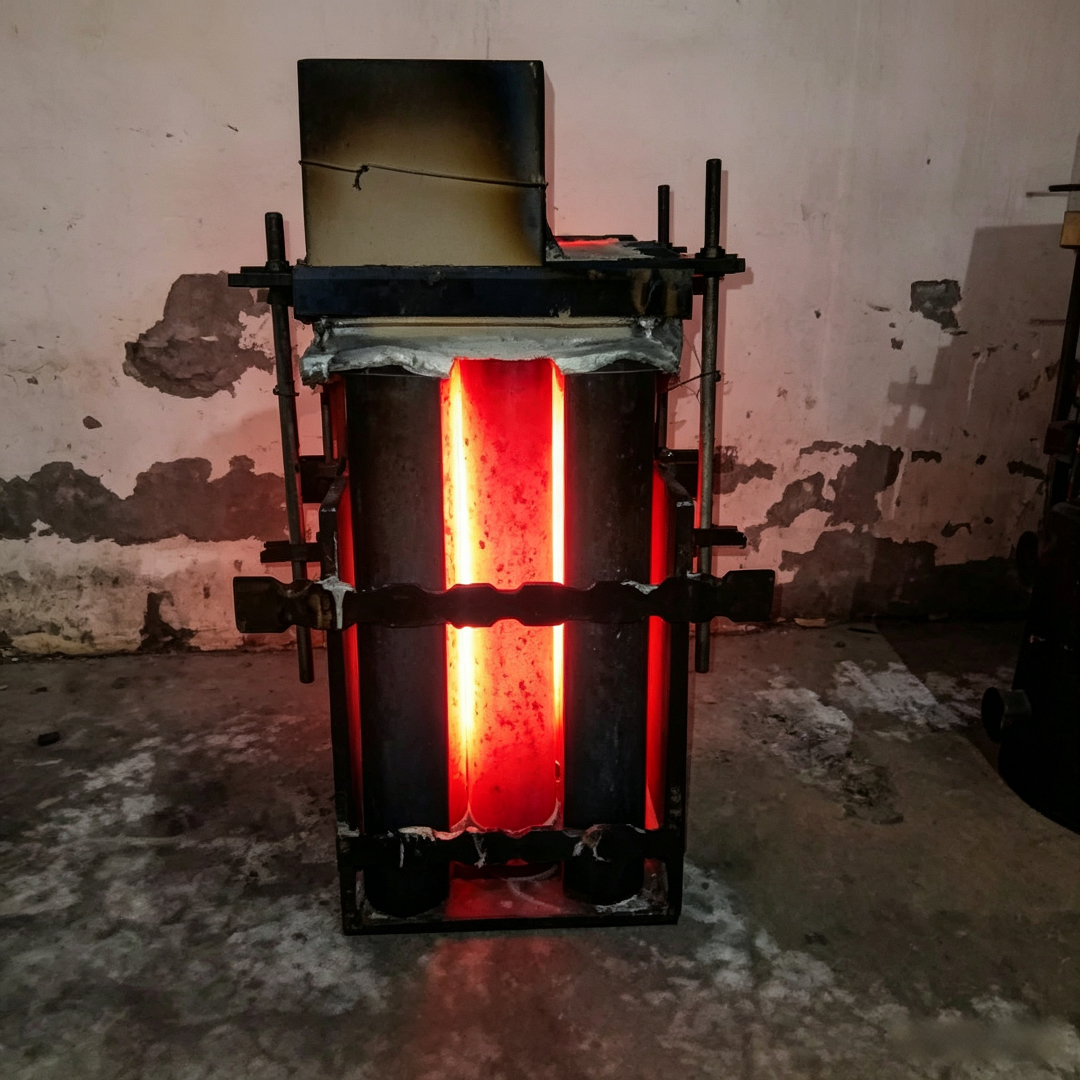
The table below gives typical compositional ranges for Alloy 713C. Exact limits should always be taken from the applicable customer specification or drawing, because different aerospace and industrial standards apply slightly different windows, particularly on carbon, boron and zirconium.
| Element | Typical Range (wt.%) | Function |
|---|---|---|
| Nickel (Ni) | Balance | Austenitic matrix, gamma-prime former |
| Chromium (Cr) | 12.0 – 14.0 | Oxidation and hot corrosion resistance |
| Aluminium (Al) | 5.5 – 6.5 | Principal gamma-prime former, protective alumina scale |
| Molybdenum (Mo) | 3.8 – 5.2 | Solid-solution strengthener |
| Niobium (Nb) | 1.8 – 2.5 | Gamma-prime stabiliser, raises solvus temperature |
| Titanium (Ti) | 0.5 – 1.0 | Gamma-prime former |
| Carbon (C) | 0.08 – 0.16 | Carbide formation at grain boundaries |
| Boron (B) | 0.008 – 0.015 | Grain-boundary strengthening |
| Zirconium (Zr) | 0.05 – 0.15 | Grain-boundary strengthening, ductility retention |
| Iron (Fe) | 1.0 max | Residual element |
Two details deserve attention from a purchasing perspective. First, carbon in 713C is deliberately higher than in the LC and ELC variants; carbon forms MC-type carbides that decorate grain boundaries and improve creep rupture life, but it also reduces ductility. Second, boron and zirconium are present in very small but critical amounts. A supplier who cannot control boron to a few parts per million cannot reliably deliver consistent 713C castings, which is why vacuum melting and tight raw-material control are essential.
Mechanical Properties and High-Temperature Performance
Inconel 713C retains useful strength up to approximately 980 °C in short-term service and is commonly used in the 700–950 °C band for turbine blades and vanes. Typical room-temperature tensile strength for cast and heat-treated material sits in the 830–950 MPa range with yield strength around 690–780 MPa and elongation of roughly 3–6%. At 800 °C, tensile strength falls to roughly 650–750 MPa while ductility improves slightly. These figures are indicative only: wall thickness, grain size, casting soundness and heat treatment all shift the numbers, and design values must come from the qualified material specification for the specific part.
The alloy’s creep resistance is its commercial raison d’être. Because the gamma-prime volume fraction is high and the precipitate is coherent with the matrix, dislocation motion is strongly impeded at temperature. That is what allows a relatively small cast blade or turbocharger wheel to survive thousands of hours of centrifugal loading in a hot gas stream.
Oxidation and Corrosion Resistance
The chromium level provides a protective chromia scale, and the aluminium content supports alumina formation under high-temperature cycling. In clean combustion environments the alloy performs well. In aggressive environments — high sulphur fuel, marine salt spray, or heavy hot-corrosion conditions — coatings such as aluminising or MCrAlY overlays are commonly applied to extend service life.
Known Limitations
- Low room-temperature ductility compared with wrought superalloys, so impact and handling damage must be avoided.
- Poor weldability: repair welding of 713C castings requires strict procedure control, preheat and post-weld heat treatment, and is often restricted by the customer specification.
- Limited machinability in the aged condition; grinding and carbide or ceramic tooling are usually required.
- Not available as wrought product; the alloy must be specified as a casting.
Where Inconel 713C Is Used
Alloy 713C is fundamentally a hot-section structural material. Its largest application is the manufacture of investment cast turbine blades and nozzle guide vanes for gas turbines, where the combination of creep strength, oxidation resistance and castability at complex wall thicknesses is difficult to match economically. Turbocharger turbine wheels for automotive, marine and heavy-duty diesel engines are another major application, particularly where the wheel is cast as a single piece with an integral hub.
Beyond aerospace and automotive, the alloy appears in industrial gas turbine components, furnace fixtures and high-temperature tooling, and in specialised hardware where moderate oxidation resistance plus high strength at 800–900 °C is required. In the medical device field, the wider family of cast and wrought superalloys is used for instruments and implant-related tooling, but implant applications themselves are normally served by other alloy families.
Because 713C castings are frequently safety-relevant, buyers increasingly demand full traceability: heat number, melt practice, chemical certificate, mechanical test results and non-destructive examination records. A capable supplier should treat this documentation as part of the product, not as an administrative extra.
How Vacuum Investment Casting Produces Reliable 713C Parts
The high aluminium and titanium content of 713C makes it highly reactive in air. Melting and pouring must therefore take place under vacuum or in a carefully controlled inert atmosphere, otherwise aluminium and titanium oxidise, inclusion content rises, and the gamma-prime forming elements are lost from the melt. Vacuum induction melting of the master alloy, followed by vacuum or controlled-atmosphere remelting for the casting operation, is the standard route.
Investment casting then proceeds through wax pattern injection, shell building, dewaxing, preheating, pouring and post-cast cleaning. Each step carries metallurgical consequences: shell preheat temperature affects grain structure, pouring temperature affects shrinkage porosity, and cooling rate affects gamma-prime size and carbide morphology. Hot isostatic pressing is frequently applied to close internal porosity in critical rotating parts, followed by solution and ageing heat treatment to homogenise the gamma-prime distribution.
Inconel 713C vs 713LC and Other Cast Superalloys
Choosing between 713C variants and neighbouring cast alloys is a routine design question. The table below summarises the practical trade-offs. Values are indicative and should be confirmed against qualified data for the specific application.
| Grade | Carbon Level | Strength | Ductility / Fatigue | Typical Use |
|---|---|---|---|---|
| Inconel 713C (UNS N07130) | Standard C | High | Moderate | Turbine blades, vanes, turbocharger wheels |
| 713LC | Low C | Slightly lower | Improved | Wheels and parts needing higher fatigue life |
| 713ELC | Extra-low C | Lower | Best in class of the three | Complex thin-wall castings, repair-sensitive parts |
| Wrought Inconel 718 | Low C | Lower at 900 °C | Excellent | Discs, shafts, forged structures below 650 °C |
The practical rule is straightforward. If the part is a casting operating between roughly 700 °C and 950 °C and the dominant requirement is creep strength, standard 713C is the default. If the part experiences thermal cycling, vibration or impact, or if thin walls and complex geometry raise casting stresses, the low-carbon variants usually give a better service life. If the part is a forged or machined rotating structure operating below about 650 °C, a wrought alloy such as 718 is the more appropriate choice.
Machining, Welding and Heat Treatment Notes
Inconel 713C in the fully heat-treated condition is abrasive and work-hardens readily. Grinding with aluminium oxide or cubic boron nitride wheels is the preferred method for dimensional finishing, and creep-feed grinding with generous coolant delivery gives the best surface integrity. When turning is unavoidable, negative-rake carbide or ceramic inserts, low surface speeds and rigid setups are required. Any machining operation should be planned so that the critical surfaces are finished after heat treatment rather than before.
Welding is the weakest point of the grade. The high aluminium and titanium content makes the alloy susceptible to strain-age cracking during post-weld heat treatment, and the cast microstructure has limited tolerance for thermal stress. Where repair welding is permitted, the procedure normally requires a qualified welding procedure specification, nickel-based filler matched to the base alloy, controlled preheat, and a post-weld heat treatment that avoids the critical cracking temperature range. Many aerospace specifications restrict weld repair of 713C to non-critical locations or prohibit it entirely, so this should be agreed before casting rather than after rejection.
Heat treatment typically involves solution treatment in the 1150–1200 °C region followed by ageing, but the exact cycle must be matched to the casting and to the specification. Over-ageing reduces strength; under-ageing leaves an inhomogeneous gamma-prime distribution and poor creep life. A supplier should be able to show the actual furnace charts, not just a certificate stating that heat treatment was performed.
Quality Assurance Checklist for Inconel 713C Buyers
When evaluating a supplier for INC 713C castings or master alloy, the following checks separate capable producers from traders. Each item is verifiable through documentation and, where appropriate, a witnessed audit.
- Chemical analysis by certified laboratory, with boron and zirconium reported numerically rather than as “present”.
- Mechanical testing of test bars cast from the same heat as the production parts.
- Non-destructive examination records: radiographic inspection for internal porosity and fluorescent penetrant inspection for surface defects.
- Heat-treatment furnace charts with time, temperature and atmosphere recorded per load.
- Traceability from raw material lot to finished casting, including master alloy source.
- Dimensional inspection reports, ideally with CMM data for critical features.
- Microstructural evaluation of gamma-prime size and carbide distribution for critical parts.
- A clear statement of weld repair policy and of any concessions applied.
Beyond the individual checks, the supplier’s melting capability matters most. A company that operates vacuum melting, precision casting and its own analytical laboratory under one roof can close the loop between chemistry, process and result. That integrated model is exactly what allows a producer to control boron at the ppm level, hold aluminium within a narrow window, and reproduce the same gamma-prime structure heat after heat — the three things that determine whether 713C castings perform as designed.
Summary
Inconel 713C (Alloy 713C, INC 713C, UNS N07130) is a cast, gamma-prime strengthened nickel-based superalloy built for sustained service in the 700–950 °C range. Its high aluminium and niobium content delivers excellent creep and oxidation resistance for turbine blades, nozzle guide vanes and turbocharger wheels, at the cost of room-temperature ductility and weldability. Low-carbon variants such as 713LC and 713ELC trade a little peak strength for better ductility and fatigue life, and wrought alloys remain the better answer for forged rotating parts below 650 °C. For buyers, the deciding factors are vacuum melt practice, control of boron and aluminium, qualified heat treatment, and complete documentation — a combination best assured by a supplier with integrated melting, casting and testing capability.